A beautiful custom wine box does a brand no good if the bottle inside arrives broken, warm, or held at a depot because nobody legal was home to sign. Shipping wine in the United States is governed by a stack of rules that have almost nothing to do with how the box looks and everything to do with who is allowed to send it, how it is tested, and how it is handled in transit. If you are a winery or a brand ordering packaging that will actually go through a parcel network, these are the standards your box has to live up to.
Who is legally allowed to ship wine
The first rule surprises people: the U.S. Postal Service prohibits mailing alcohol entirely, so USPS is simply not an option for wine. That leaves FedEx and UPS, and both allow wine only from licensed businesses that have signed a formal agreement. FedEx calls it an Alcohol Shipping Agreement; UPS enrolls approved senders as Approved Wine Shippers. In both cases the shipper must hold the appropriate alcohol licenses and ship through the carrier’s electronic system rather than a plain airbill. Individual consumers cannot legally ship wine through these carriers at all. On FedEx, domestic alcohol shipments also require a specific alcohol shipping label, the SEL 169, generated through FedEx Ship Manager or an approved third-party system with the alcohol option selected.
None of this is packaging you can buy your way around; it is account-level compliance the shipper arranges with the carrier. But it shapes your packaging decisions, because a carrier that has agreed to move your wine also expects the parcel to meet their handling and labeling requirements, and a box that ignores those expectations can get a shipment refused or an account flagged.
The delivery rule that catches shippers out
Every U.S. package containing alcohol requires an adult signature at delivery, and both major carriers enforce it without exception. The person signing must be 21 or older and must present an acceptable photo ID such as a driver’s license or passport. There is no leaving it on the porch. That single rule has real consequences for how you package and program a shipment: deliveries to a business address during working hours succeed far more often than deliveries to an empty home, and a missed signature means reattempts, delay, and a bottle riding around in a truck through more temperature swings than you intended. Good wine shippers plan the delivery window as carefully as the box.
What an ISTA 3A tested box actually proves
When a packaging supplier says a wine mailer is tested or certified, the standard they almost always mean is ISTA 3A. It is a test protocol from the International Safe Transit Association designed for individually packaged products weighing 150 pounds or less that move through a parcel delivery network, which is exactly what a direct-to-consumer wine shipment is. Rather than a single drop, ISTA 3A runs a sequence that mimics the real journey: atmospheric preconditioning to set temperature and humidity, a first shock sequence of drops from heights that scale with the package weight and target the most vulnerable corners and edges, random vibration with a top load to simulate stacked over-the-road transport, random vibration without a top load to represent the delivery van, and a final shock sequence including an edge drop.
The important part for a buyer is what certification means. A pass from an ISTA-certified third-party lab carries weight with carriers, retailers, and insurers that an in-house claim does not. If breakage and the resulting claims are a real cost in your program, specifying packaging validated to ISTA 3A is how you move that risk off your own ledger. Ask whether the specific configuration you are ordering, meaning the same insert and bottle count, was the one tested, because a two-bottle result does not automatically transfer to a six-bottle box.
Packaging and temperature: what passes and what protects
Carriers and test labs converge on the same packaging logic: a rigid, cushioned inner structure that immobilizes each bottle, inside a sturdy outer corrugated carton. Accepted inner protection includes molded expanded polystyrene, molded pulp or fiber trays with dividers, thermoformed plastic trays, and die-cut corrugated units. The goal is that bottles cannot shift, touch each other, or contact the outer wall, since bottle-on-bottle impact is the most common breakage mode. Wrapping bottles in tissue, filling voids so nothing moves, and taping all seams are the finishing steps that turn a good insert into a package that survives.
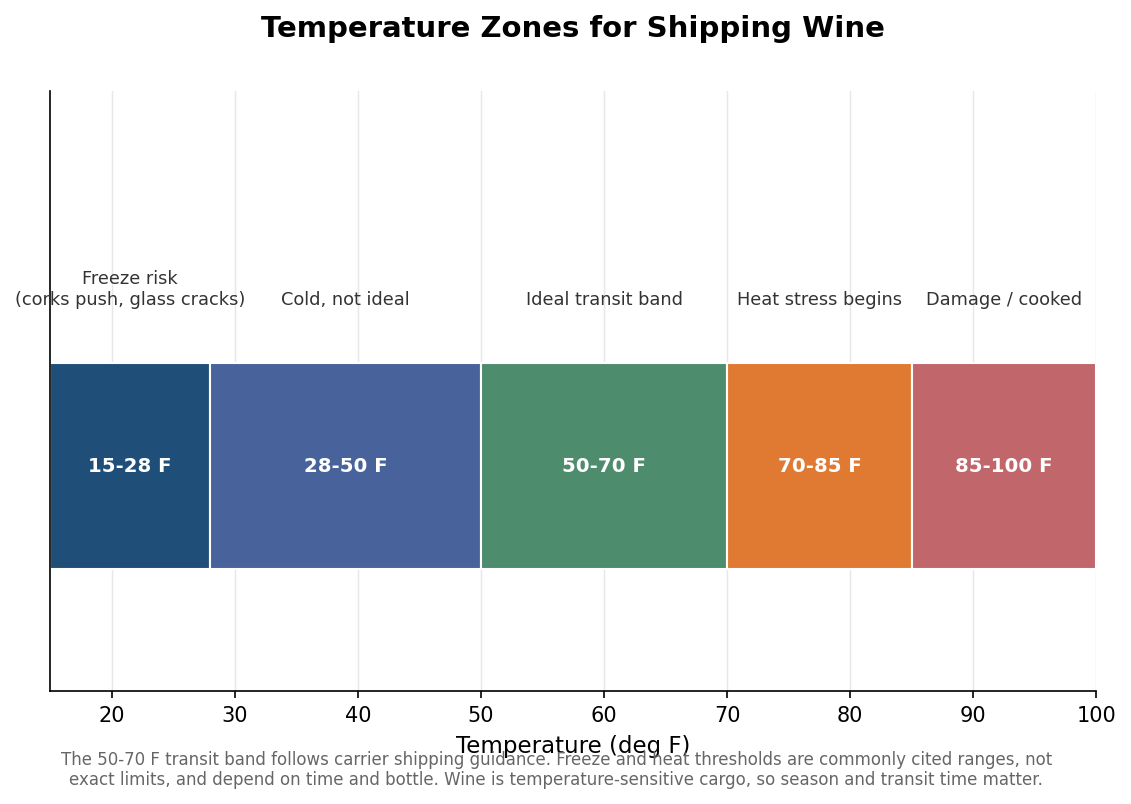
Then there is temperature, which is where wine differs from ordinary cargo. Carriers advise a transit band of roughly 50 to 70 degrees Fahrenheit, and the further a shipment strays from it, the more the wine is at risk. The chart below sketches the practical zones. Cold is the lesser danger until it reaches freezing, where expanding wine can push corks and crack glass; heat is the quieter killer, because a bottle that spends a summer afternoon in a hot truck can be cooked without any visible sign until it is opened. This is why serious wine shippers favor spring and fall, add insulation or cold packs in extreme seasons, and choose faster service when the forecast is bad.
Weight, handling, and the box you actually order
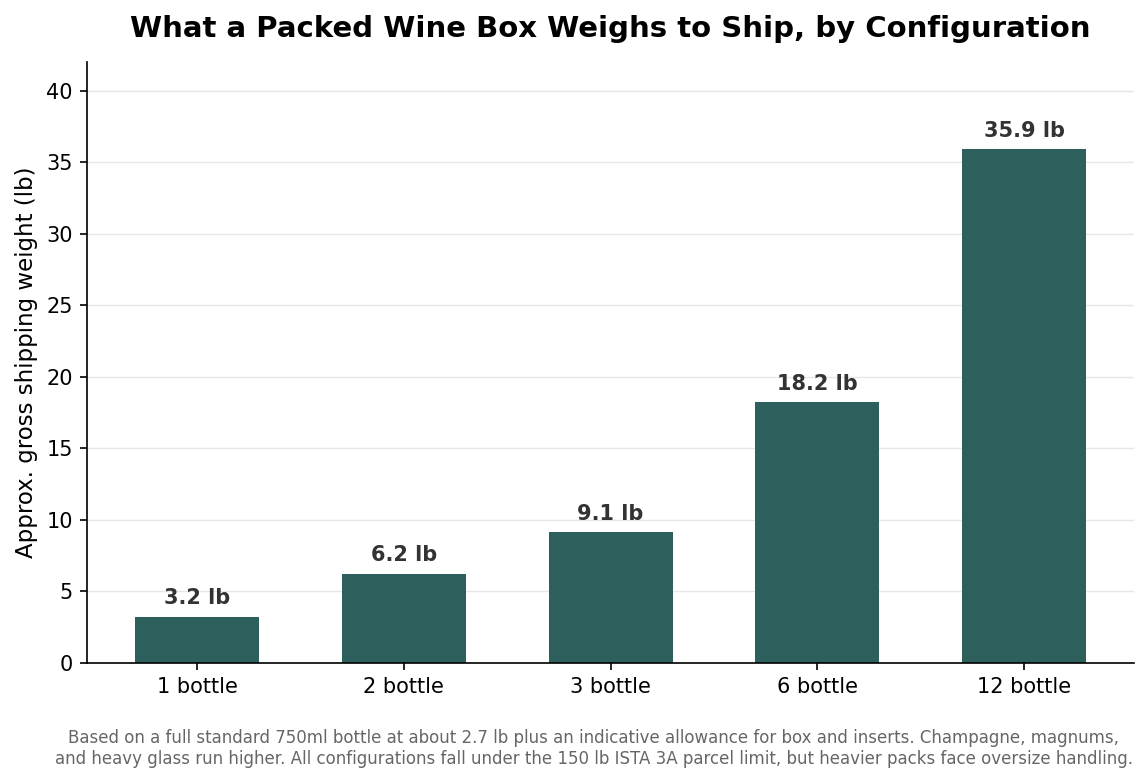
Finally, the physical box interacts with the carrier’s handling in ways worth planning for. A full standard 750-milliliter bottle weighs roughly 2.7 pounds, and heavier glass, Champagne, and magnums run higher, so a packed case adds up quickly. The chart below shows indicative gross shipping weights by configuration, including a rough allowance for the box and inserts. Every configuration sits comfortably under the 150-pound ISTA 3A parcel ceiling, but the practical constraints arrive much sooner: heavier six- and twelve-bottle packs cross into oversize handling and higher dimensional-weight charges, and a heavy box with a weak insert concentrates more force on the bottles during the very drops ISTA 3A is testing for.
The takeaway is that a wine box is a compliance and engineering decision before it is a design decision. Confirm the shipper is a licensed, agreement-holding sender on FedEx or UPS, plan for the mandatory adult signature, specify packaging validated to ISTA 3A in the exact configuration you will ship, protect against temperature as deliberately as against impact, and size the box so its packed weight stays in a range the carrier handles cleanly. Get those numbers right and the box is then free to be as beautiful as you like, because it will actually arrive that way.