The box everyone photographs is the outer shipper. The part that actually keeps four figures of glass intact from your dock to a customer’s doorstep is the insert inside it. A wine box insert cradles each bottle, stops glass from touching glass, and absorbs the drops and vibration that every parcel takes in transit. Choose it wrong and you pay for it in breakage claims, refunds, and one-star reviews. Three materials dominate the category, and they behave very differently.
The three insert materials, side by side
Molded pulp is formed from recycled paper slurry into trays with bottle-shaped cavities. Each bottle sits in its own cradle, fixed and isolated, with no room to shift. It is the workhorse of direct-to-consumer wine shipping because it immobilizes bottles cleanly, uses recycled content, and nests flat for storage. Its weakness is cushioning: pulp resists and holds a bottle in place, but it does not deform and rebound the way foam does, so it offers less protection against a hard, concentrated impact.
EPS foam (expanded polystyrene) is roughly 98% trapped air in a closed-cell structure, which makes it the best pure shock absorber of the three. It decelerates a falling bottle gradually and buys you a real thermal buffer, holding a stable internal temperature for an indicative 48 to 72 hours in transit. That matters for ultra-premium bottles and for summer shipping. The trade-offs are environmental and logistical: EPS is not curbside recyclable and is restricted or banned from disposal in several states, and because it does not nest, you effectively ship and store air.
Corrugated inserts, meaning die-cut dividers and partitions, organize and separate bottles rather than cushion them. They are the lightest and cheapest option and flat-pack efficiently, but on their own they are not enough protection for glass on a long parcel route. Corrugated shines as a secondary layer or for local, hand-carried delivery, not as the sole defense for a coast-to-coast shipment.
Matching the insert to the bottle and the route
The single most useful rule in this category is the half-inch immobilization standard: a bottle should not be able to move more than about half an inch inside its packaging in any direction. Movement is what turns a normal delivery jostle into a broken neck or a scuffed label. Both molded pulp and well-designed foam meet this standard when the cavity is sized to the bottle; generic cut shapes that leave slack do not.
Fit depends on bottle geometry, and wine bottles are not uniform. Most trays are built to accept a bottle diameter of roughly 2.8 to 3.5 inches and a height of about 10 to 14 inches, which covers standard Bordeaux and most Burgundy shapes. A heavy sparkling bottle with a wider base and a punt, or a tall dessert-wine bottle, can fall outside a standard cavity, so confirm the tray was formed for your actual SKU before you commit to a run. Outer shipper dimensions scale with count: a single-bottle mailer runs around 4 by 4 by 15 inches, while a twelve-bottle case lands near 20 by 12 by 14 inches once the trays and outer box are assembled.
What the shipping tests actually check
Reputable shippers are validated against a transit-simulation protocol rather than a vendor’s promise. The two names you will see are ISTA 3A, a general parcel-delivery simulation for individually shipped packages, and carrier-specific programs such as ISTA 6-FedEx-A, which mirrors how a specific carrier’s network actually handles boxes. Both put a packed shipper through a sequence of drops, random vibration on a shaker table, and atmospheric conditioning for temperature and humidity, then check whether the contents survived. Exact drop heights and cycle counts vary by protocol and package weight and are best confirmed with the test report, but the principle is constant: the certification describes the packed system, not the tray alone. A pulp tray that passes in a specific outer box tells you nothing if you swap in a thinner carton.
If you ship through a single carrier, a shipper certified to that carrier’s program is the most direct evidence it will hold up. If you use mixed carriers or your own logistics, an ISTA 3A pass is the broader baseline. Ask any supplier for the actual report and the box configuration it was run in.
Cost, storage, and sustainability
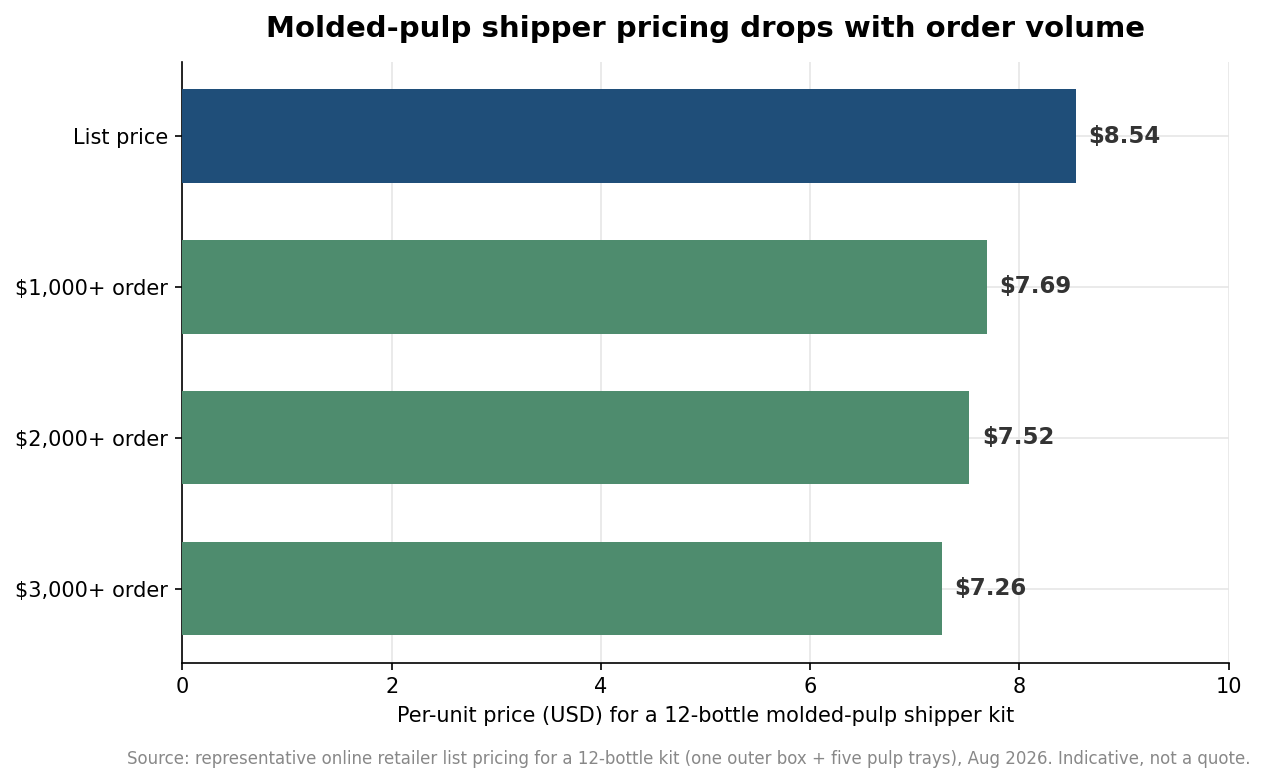
Sticker price per shipper is only part of the real cost. A representative twelve-bottle molded-pulp kit, meaning one outer box plus five nesting trays, lists around $8.54 per unit and steps down with volume to roughly $7.26 at higher order values, with minimums often starting near ten units. Those are indicative retail figures, not a quote, but they show the shape: this is a volume-priced product where committing to a full run meaningfully lowers the per-unit cost.
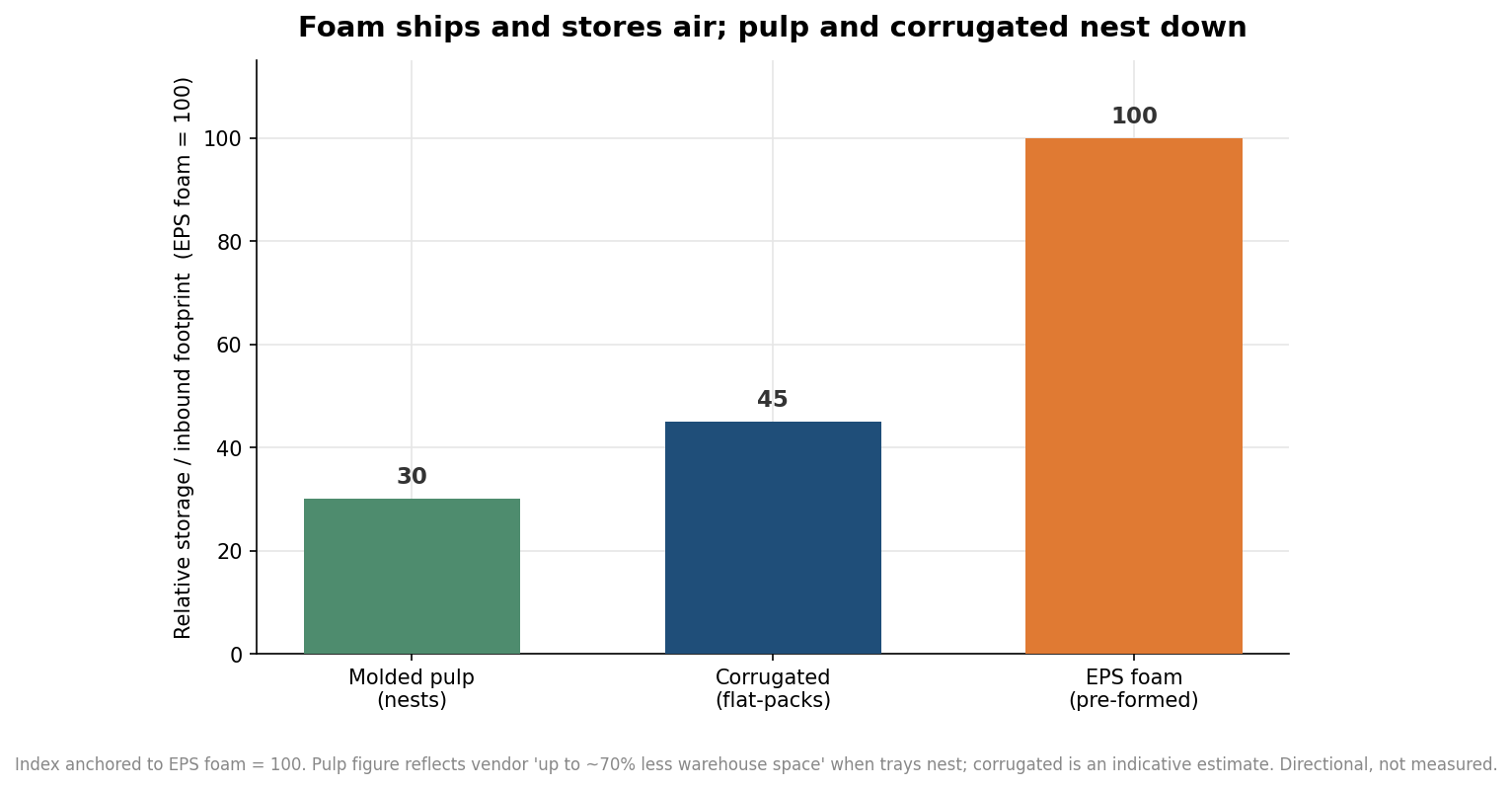
The hidden costs favor pulp and corrugated. Because they nest or flat-pack, they cut inbound freight and warehouse footprint dramatically, while pre-formed foam occupies its full volume from the day it arrives. Vendors cite pulp trays taking up to about 70% less storage space than the equivalent foam. Sustainability runs the same direction: molded pulp is typically 100% recycled content and curbside recyclable or compostable in most markets, which increasingly matters to retailers that now require plastic-free packaging. Foam wins on cushioning and thermal hold; it loses on disposal and storage.
Choosing for your shipment
Reason from the shipment, not the material. For everyday direct-to-consumer orders of standard bottles moving through a parcel carrier, molded pulp is the default: it immobilizes reliably, tests well, stores flat, and carries the eco story most wine buyers expect. Step up to EPS foam when the bottle is genuinely high-value, the route is long or international, or heat is a real risk and the thermal buffer earns its logistical cost. Reserve corrugated for local delivery, retail-ready packs, or as reinforcement layered with another material. Whatever you choose, size the cavity to your exact bottle, ask for the transit-test report and the configuration behind it, and price it at the volume you will actually order rather than the single-unit rate. That is the difference between packaging that survives the truck and packaging that generates claims.