Most wine box fit problems start with a single wrong assumption: that “750 milliliters” describes one bottle. It does not. A standard-volume bottle can be a slim Bordeaux, a broad-shouldered Burgundy, or a wide Champagne bottle, and each one asks a different question of the box around it. Get the box right and the bottle sits snug and presents well; get it wrong and you either can’t close the lid or the bottle rattles loose. If you are specifying a custom wine box, the smart starting point is not the box at all, but the exact bottle it has to hold.
A “750ml” bottle comes in several shapes
Four bottle families cover most of what a winery or gifter will pack. The Bordeaux bottle is the tall, straight-sided one with high shoulders, and at roughly three inches in diameter it is the narrowest of the common shapes. The Burgundy bottle, used for Pinot Noir and Chardonnay, is a little shorter in the shoulder and noticeably wider, around 3.2 to 3.5 inches across, with a gentle slope instead of a hard shoulder. The Champagne bottle is wider still and heavier, typically 3.5 to 3.75 inches in diameter with thick glass and a deep punt to handle pressure. Then there is the magnum, the 1.5-liter format, which jumps to about four inches in diameter and roughly fourteen inches tall. Slim Alsace and Rhine flutes go the other way, staying narrow but running tall.
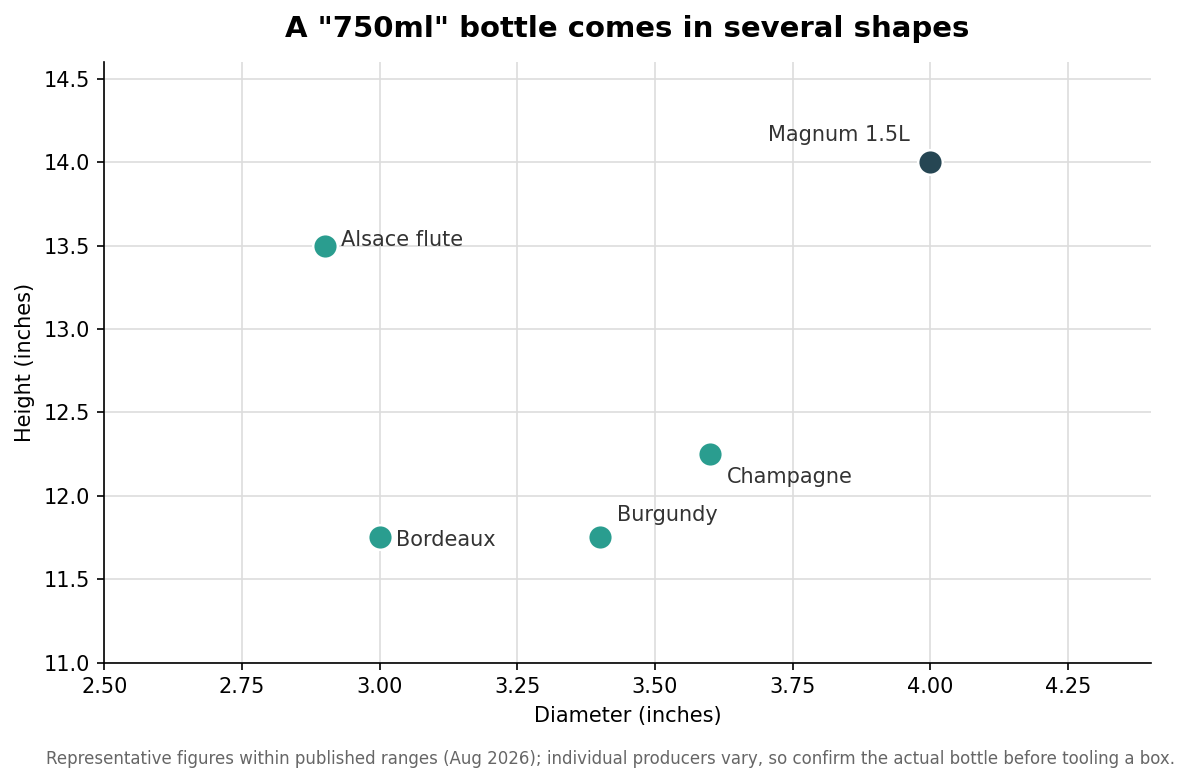
The chart plots those shapes on the two axes that actually matter to a box: width and height. Notice that the bottles do not line up on a single trend. A Champagne bottle is short and fat relative to a flute, which is tall and thin, so a box sized to comfortably hold one may not close over the other even though both contain the same 750 milliliters.
Diameter drives the box footprint
Between the two dimensions, diameter is usually the one that trips people up, because it varies more in proportion and because the insert has to wrap around it. The rule for a single-bottle box is simple: the widest bottle you intend to pack sets the internal width, and you add clearance on top of the bare glass for the insert wall and an easy fit. A snug foam-lined rigid box needs only a little; a molded-pulp shipper that cradles the bottle needs more. The chart below shows a practical minimum internal width for each shape, built from the bottle diameter plus an indicative clearance allowance.
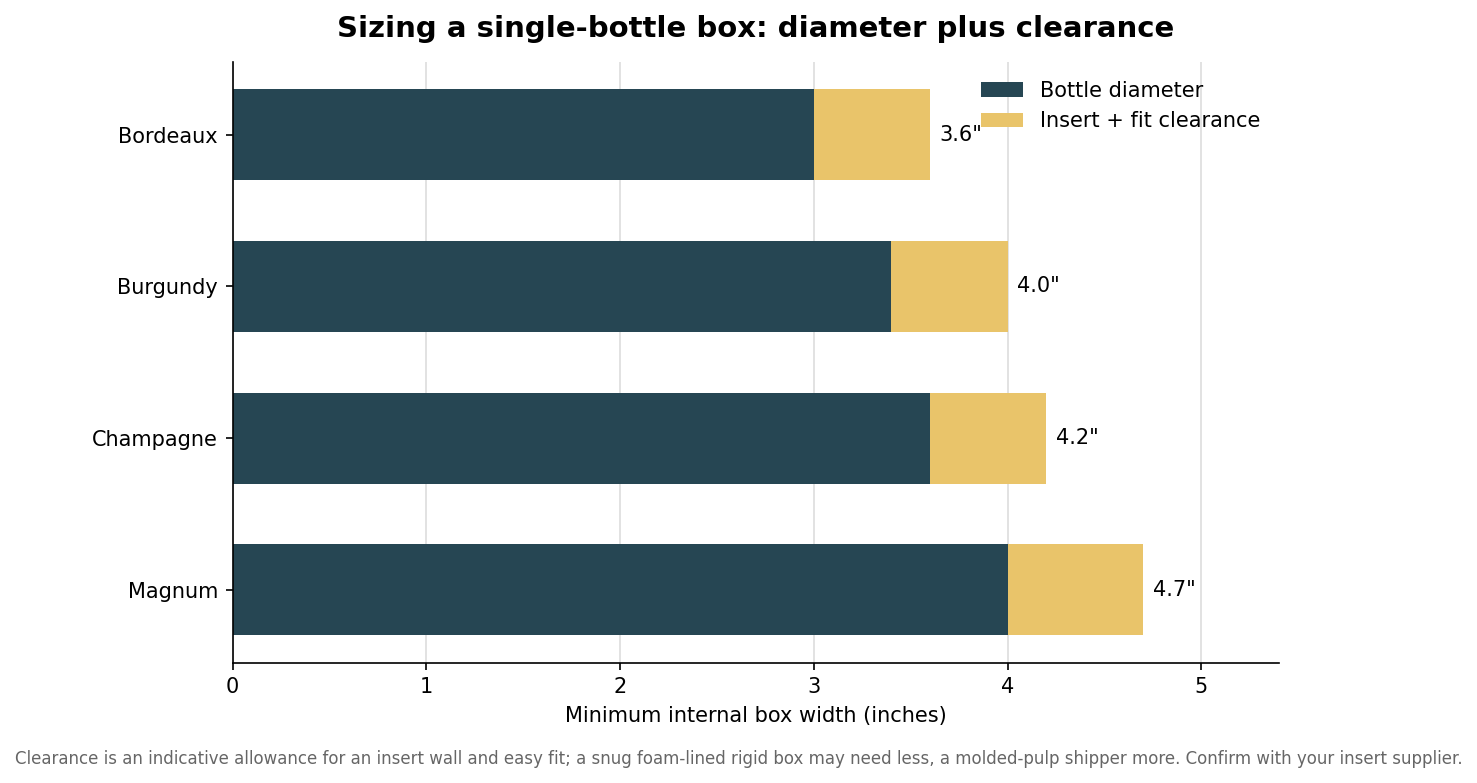
The takeaway is that a box comfortable for a Bordeaux, at roughly three and a half inches inside, will pinch a Champagne bottle that wants closer to four and a quarter. If your range spans shapes, you either design to the widest bottle or you accept that the narrow bottles will need a thicker insert to sit centered and secure.
Height, necks, and closures need their own clearance
Height looks straightforward until you remember that the box has to do more than clear the glass. The bottle has to drop in and the lid has to close over it, so the internal height needs headroom above the capsule for the closure, and a base insert or pad below adds a little too. Tall formats are where this bites: a magnum near fourteen inches, or a slender flute at thirteen to fourteen, can exceed a box tooled for standard Bordeaux height even though the diameter is fine. It is worth measuring the tallest bottle from base to the very top of the capsule, then adding clearance for the lid mechanism and any padding, rather than trusting a nominal bottle height. The deep punt on a Champagne or magnum bottle also means the base is not flat in the way a cheap insert assumes, so the cradle has to support the bottle at the heel, not the center.
The insert decides how much clearance you actually need
Clearance is not a fixed number because it depends on how the bottle is held. A die-cut foam or EVA insert grips the glass tightly and needs very little slack, which gives the most premium, motionless feel in hand and is common in luxury rigid boxes. Molded pulp and molded fiber cradles are more forgiving and more sustainable, but their walls are thicker and they are sized in steps rather than to the exact millimeter, so they eat more internal space. Corrugated dividers are the loosest and cheapest, fine for shipping multiples but not for a gift presentation. Because the insert and the box are a system, the sensible order of decisions is bottle first, then insert, then the box dimensions that the chosen insert requires, not the other way around.
Specifying one box for a mixed range
Wineries and gift companies often want a single box that works across their lineup, and that is achievable if you design deliberately. Size the internal footprint to the widest and tallest bottle you sell, then let a stepped or adjustable insert take up the slack for the smaller shapes, so a Bordeaux, a Burgundy, and a Champagne bottle can all present centered in the same outer box. The alternative is separate box SKUs per format, which looks and fits better but multiplies tooling, inventory, and minimum-order commitments. Neither is wrong; it is a trade between a tidy single stock item and a perfect fit for every bottle. Whichever way you go, the discipline is the same: measure the real bottles, choose the insert that holds them the way you want, and only then lock the box dimensions. Do that and the fit problems that plague off-the-shelf packaging simply do not arise.